

CD59 Rabbit mAb, Unconjugated, Monoclonal
Artikelnummer:
ABB-A22667
- Bilder (1)
| Artikelname: | CD59 Rabbit mAb, Unconjugated, Monoclonal |
| Artikelnummer: | ABB-A22667 |
| Hersteller Artikelnummer: | A22667 |
| Alternativnummer: | ABB-A22667-20UL,ABB-A22667-100UL |
| Hersteller: | ABclonal |
| Wirt: | Rabbit |
| Kategorie: | Antikörper |
| Applikation: | ELISA, WB |
| Spezies Reaktivität: | Human |
| Immunogen: | Synthetic peptide. This information is considered to be commercially sensitive. |
| Konjugation: | Unconjugated |
| Alternative Synonym: | 1F5, EJ16, EJ30, EL32, G344, MIN1, MIN2, MIN3, MIRL, HRF20, MACIF, MEM43, MIC11, MSK21, 16.3A5, HRF-20, MAC-IP, p18-20, CD59 |
| This gene encodes a cell surface glycoprotein that regulates complement-mediated cell lysis, and it is involved in lymphocyte signal transduction. This protein is a potent inhibitor of the complement membrane attack complex, whereby it binds complement C8 and/or C9 during the assembly of this complex, thereby inhibiting the incorporation of multiple copies of C9 into the complex, which is necessary for osmolytic pore formation. This protein also plays a role in signal transduction pathways in the activation of T cells. Mutations in this gene cause CD59 deficiency, a disease resulting in hemolytic anemia and thrombosis, and which causes cerebral infarction. Multiple alternatively spliced transcript variants, which encode the same protein, have been identified for this gene. |
| Application Verdünnung: | WB,1:2000 - 1:10000|ELISA,Recommended starting concentration is 1 µg/mL. Please optimize the concentration based on your specific assay requirements. |
| Anwendungsbeschreibung: | Cross-Reactivity: Human. ResearchArea: Signal Transduction,Kinase,Tyrosine kinases,Immunology Inflammation,CDs,Cell Intrinsic Innate Immunity Signaling Pathway,Stem Cells,Hematopoietic Progenitors,Cardiovascular. Shipping: Ice Bag |
|
|
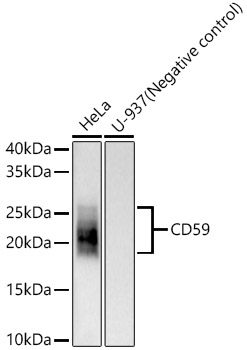
Western blot analysis of lysates from HeLa cells using CD59 Rabbit mAb (A22667) at 1:5000 dilution incubated overnight at 4°C. Secondary antibody: HRP-conjugated Goat anti-Rabbit IgG (H+L) (AS014) at 1:10000 dilution. Lysates/proteins: 25 µg per lane. Blocking buffer: 3% nonfat dry milk in TBST. Detection: ECL Basic Kit (RM00020). Exposure time: 20 s. |
Produktgarantie und fachkundiger Support
