S100A8 is a low molecular weight (10 kDa) secreted cytoplasmic protein belonging to S100 family of calcium- and zinc-binding protein. S100A8 regulates a number of cellular processes, such as, inflammation, antimicrobial, oxidant-scavenging and apoptosis-inducing activities, cell cycle progression and differentiation, leukocyte arachidonic acid trafficking and metabolism. S100A8 is a homodimer but predominantly remains as heterodimer with S100A9 and the S100A8/S100A9 complex is called as Calprotectin. S100A8 is generally expressed in myeloid cells, neutrophils, monocytes and keratinocytes but high levels are found in the serum sample of patients with inflammatory diseases, such as, rheumatoid, cystic fibrosis, inflammatory bowel disease, systemic lupus erythematosus, progressive systemic sclerosis and many other inflammatory diseases. S100A8 is also associated with Psoriasis (an inflammatory skin disorder characterized by keratinocyte hyperproliferation and altered differentiation).
Western Blot analysis: 2-4 µg/ml, Flowcytometric analysis: 2-4 µg/10 6 cells
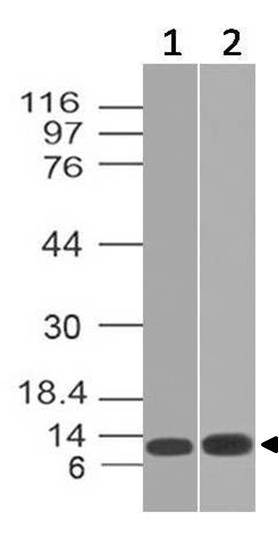
Figure-1: Western blot analysis of mS100A8. Anti-mS100A8 antibody (Clone: ABM4A69) was used at 2 µg/ml on mSKM and mOvary lysates.
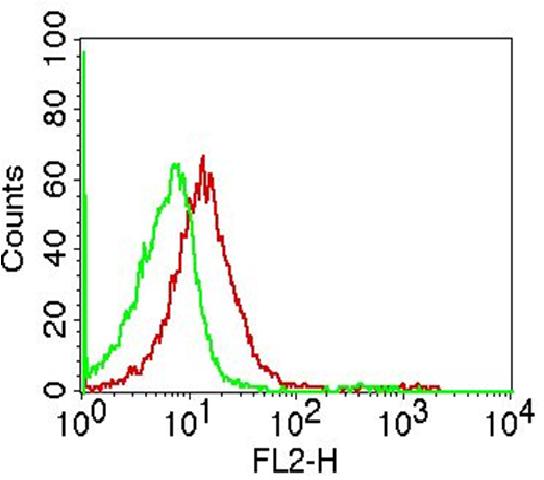
Figure-2: Intracellular flow cytometric analysis of mouse S100A8 on murine splenocytes using 2 µg/ 10 6 cells of antibody (Clone: ABM4A69). Goat anti-rat PE conjugate was used as secondary. Green represents isotype control, red represents anti-S100A8 antibody.
* Mehrwertsteuer und Versandkosten nicht enthalten. Irrtümer und Preisänderungen vorbehalten