

Apoe Rabbit pAb, Unconjugated, Polyclonal
Catalog Number:
ABB-A16344
- Images (1)
| Article Name: | Apoe Rabbit pAb, Unconjugated, Polyclonal |
| Biozol Catalog Number: | ABB-A16344 |
| Supplier Catalog Number: | A16344 |
| Alternative Catalog Number: | ABB-A16344-100UL,ABB-A16344-20UL,ABB-A16344-1000UL,ABB-A16344-500UL |
| Manufacturer: | ABclonal |
| Host: | Rabbit |
| Category: | Antikörper |
| Application: | ELISA, WB |
| Species Reactivity: | Mouse |
| Immunogen: | Synthetic peptide. This information is considered to be commercially sensitive. |
| Conjugation: | Unconjugated |
| Alternative Names: | Apo-E, Apoe |
| This gene encodes a member of the apolipoprotein A1/A4/E family of proteins. This protein is involved in the transport of lipoproteins in the blood. It binds to a specific liver and peripheral cell receptor, and is essential for the normal catabolism of triglyceride-rich lipoprotein constituents. Homozygous knockout mice for this gene accumulate high levels of cholesterol in the blood and develop atherosclerosis. Different alleles of this gene have been associated with either increased risk or a protective effect for Alzheimers disease in human patients. This gene maps to chromosome 7 in a cluster with the related apolipoprotein C1, C2 and C4 genes. |
| Application Dilute: | WB,1:500 - 1:5000|ELISA,Recommended starting concentration is 1 µg/mL. Please optimize the concentration based on your specific assay requirements. |
| Application Notes: | Cross-Reactivity: Human,Mouse. ResearchArea: Cancer,Signal Transduction,Cell Biology & Developmental Biology,Endocrine & Metabolism,Lipid Metabolism,Cholesterol Metabolism,Neuroscience,Neurodegenerative Diseases,Amyloid Plaque and Neurofibrillary Tangle Formation in Alzheimers Disease,Stem Cells,Cardiovascular,Lipids,Lipoproteins/Apolipoproteins. Shipping: Ice Bag |
|
|
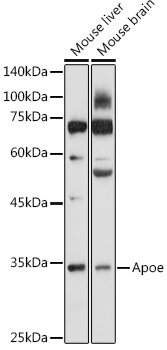
Western blot analysis of various lysates using Apoe Rabbit pAb (A16344) at 1:1000 dilution. Secondary antibody: HRP-conjugated Goat anti-Rabbit IgG (H+L) (AS014) at 1:10000 dilution. Lysates/proteins: 25µg per lane. Blocking buffer: 3% nonfat dry milk in TBST. Detection: ECL Basic Kit (RM00020). Exposure time: 30s. |
Product Guarantee and Expert Support
