

OR1A1 Rabbit pAb, Unconjugated, Polyclonal
Catalog Number:
ABB-A16453
- Images (1)
| Article Name: | OR1A1 Rabbit pAb, Unconjugated, Polyclonal |
| Biozol Catalog Number: | ABB-A16453 |
| Supplier Catalog Number: | A16453 |
| Alternative Catalog Number: | ABB-A16453-20UL,ABB-A16453-100UL,ABB-A16453-1000UL,ABB-A16453-500UL |
| Manufacturer: | ABclonal |
| Host: | Rabbit |
| Category: | Antikörper |
| Application: | ELISA, WB |
| Species Reactivity: | Human |
| Immunogen: | Synthetic peptide. This information is considered to be commercially sensitive. |
| Conjugation: | Unconjugated |
| Alternative Names: | OR17-7, OR1A1 |
| Olfactory receptors interact with odorant molecules in the nose, to initiate a neuronal response that triggers the perception of a smell. The olfactory receptor proteins are members of a large family of G-protein-coupled receptors (GPCR) arising from single coding-exon genes. Olfactory receptors share a 7-transmembrane domain structure with many neurotransmitter and hormone receptors and are responsible for the recognition and G protein-mediated transduction of odorant signals. The olfactory receptor gene family is the largest in the genome. The nomenclature assigned to the olfactory receptor genes and proteins for this organism is independent of other organisms. |
| Application Dilute: | WB,1:500 - 1:2000|ELISA,Recommended starting concentration is 1 µg/mL. Please optimize the concentration based on your specific assay requirements. |
| Application Notes: | Cross-Reactivity: Human,Mouse,Rat. ResearchArea: Signal Transduction,G protein signaling,G-Protein-Coupled ReceptorsGPCR,Neuroscience. Shipping: Ice Bag |
|
|
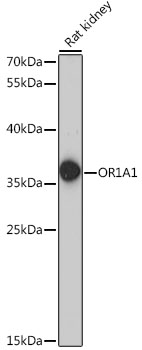
Western blot analysis of lysates from rat kidney, using OR1A1 Rabbit pAb (A16453) at 1:1000 dilution. Secondary antibody: HRP-conjugated Goat anti-Rabbit IgG (H+L) (AS014) at 1:10000 dilution. Lysates/proteins: 25µg per lane. Blocking buffer: 3% nonfat dry milk in TBST. Detection: ECL Basic Kit (RM00020). Exposure time: 60s. |
Product Guarantee and Expert Support
