

PAI-1/Serpin E1 Rabbit mAb, Unconjugated, Monoclonal
Catalog Number:
ABB-A19096
- Images (1)
| Article Name: | PAI-1/Serpin E1 Rabbit mAb, Unconjugated, Monoclonal |
| Biozol Catalog Number: | ABB-A19096 |
| Supplier Catalog Number: | A19096 |
| Alternative Catalog Number: | ABB-A19096-20UL,ABB-A19096-100UL |
| Manufacturer: | ABclonal |
| Host: | Rabbit |
| Category: | Antikörper |
| Application: | ELISA, WB |
| Species Reactivity: | Human |
| Immunogen: | Synthetic peptide. This information is considered to be commercially sensitive. |
| Conjugation: | Unconjugated |
| Alternative Names: | PAI, PAI1, PAI-1, PLANH1, PAI-1/Serpin E1 |
| This gene encodes a member of the serine proteinase inhibitor (serpin) superfamily. This member is the principal inhibitor of tissue plasminogen activator (tPA) and urokinase (uPA), and hence is an inhibitor of fibrinolysis. The protein also functions as a component of innate antiviral immunity. Defects in this gene are the cause of plasminogen activator inhibitor-1 deficiency (PAI-1 deficiency), and high concentrations of the gene product are associated with thrombophilia. |
| Application Dilute: | WB,1:1000 - 1:4000|ELISA,Recommended starting concentration is 1 µg/mL. Please optimize the concentration based on your specific assay requirements. |
| Application Notes: | Cross-Reactivity: Human,Monkey. ResearchArea: Cancer,Tumor biomarkers,Signal Transduction,Cell Biology Developmental Biology,Ubiquitin,Endocrine Metabolism,Endocrine and metabolic diseases,Cardiovascular,Angiogenesis,Blood. Shipping: Ice Bag |
|
|
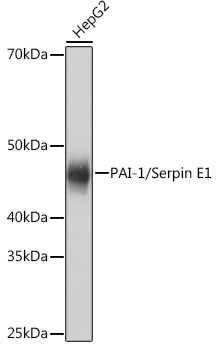
Western blot analysis of various lysates using PAI-1/Serpin E1 Rabbit mAb (A19096) at 1:1000 dilution incubated overnight at 4°C. Secondary antibody: HRP-conjugated Goat anti-Rabbit IgG (H+L) (AS014) at 1:10000 dilution. Lysates/proteins: 25 µg per lane. Blocking buffer: 3% nonfat dry milk in TBST. Detection: ECL Basic Kit (RM00020). Exposure time: 45s. |
Product Guarantee and Expert Support
