

Caspr2/CNTNAP2 Rabbit mAb, Unconjugated, Monoclonal
Catalog Number:
ABB-A19262
- Images (1)
| Article Name: | Caspr2/CNTNAP2 Rabbit mAb, Unconjugated, Monoclonal |
| Biozol Catalog Number: | ABB-A19262 |
| Supplier Catalog Number: | A19262 |
| Alternative Catalog Number: | ABB-A19262-100UL,ABB-A19262-20UL |
| Manufacturer: | ABclonal |
| Host: | Rabbit |
| Category: | Antikörper |
| Application: | ELISA, WB |
| Species Reactivity: | Human |
| Immunogen: | Synthetic peptide. This information is considered to be commercially sensitive. |
| Conjugation: | Unconjugated |
| Alternative Names: | CDFE, NRXN4, AUTS15, CASPR2, PTHSL1, Caspr2/CNTNAP2 |
| This gene encodes a member of the neurexin family which functions in the vertebrate nervous system as cell adhesion molecules and receptors. This protein, like other neurexin proteins, contains epidermal growth factor repeats and laminin G domains. In addition, it includes an F5/8 type C domain, discoidin/neuropilin- and fibrinogen-like domains, thrombospondin N-terminal-like domains and a putative PDZ binding site. This protein is localized at the juxtaparanodes of myelinated axons, and mediates interactions between neurons and glia during nervous system development and is also involved in localization of potassium channels within differentiating axons. This gene encompasses almost 1.5% of chromosome 7 and is one of the largest genes in the human genome. It is directly bound and regulated by forkhead box protein P2, a transcription factor related to speech and language development. This gene has been implicated in multiple neurodevelopmental disorders, including Gilles de la Tourette syndrome, schizophrenia, epilepsy, autism, ADHD and intellectual disability. |
| Application Dilute: | WB,1:1000 - 1:6000|ELISA,Recommended starting concentration is 1 µg/mL. Please optimize the concentration based on your specific assay requirements. |
| Application Notes: | Cross-Reactivity: Mouse,Rat. ResearchArea: Neuroscience, Cell Type Marker. Shipping: Ice Bag |
|
|
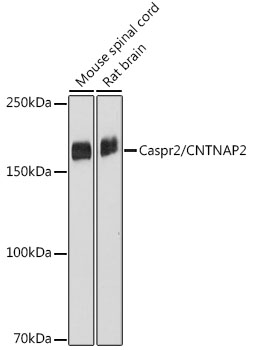
Western blot analysis of various lysates using Caspr2/CNTNAP2 Rabbit mAb (A19262) at 1:1000 dilution. Secondary antibody: HRP-conjugated Goat anti-Rabbit IgG (H+L) (AS014) at 1:10000 dilution. Lysates/proteins: 25µg per lane. Blocking buffer: 3% nonfat dry milk in TBST. Detection: ECL Basic Kit (RM00020). Exposure time: 10s. |
Product Guarantee and Expert Support
