

Lactic acid-Histone H3-K18 Rabbit mAb, Unconjugated
Catalog Number:
ABB-A21214
- Images (1)
| Article Name: | Lactic acid-Histone H3-K18 Rabbit mAb, Unconjugated |
| Biozol Catalog Number: | ABB-A21214 |
| Supplier Catalog Number: | A21214 |
| Alternative Catalog Number: | ABB-A21214-100UL,ABB-A21214-20UL,ABB-A21214-500UL,ABB-A21214-1000UL |
| Manufacturer: | ABclonal |
| Host: | Rabbit |
| Category: | Antikörper |
| Application: | DOT, ELISA, WB |
| Species Reactivity: | Human |
| Immunogen: | Synthetic peptide. This information is considered to be commercially sensitive. |
| Conjugation: | Unconjugated |
| Alternative Names: | H3/A, H3C2, H3C3, H3C4, H3C6, H3C7, H3C8, H3FA, H3C10, H3C11, H3C12, HIST1H3A, Lactic acid-Histone H3-K18 |
| Histones are basic nuclear proteins that are responsible for the nucleosome structure of the chromosomal fiber in eukaryotes. This structure consists of approximately 146 bp of DNA wrapped around a nucleosome, an octamer composed of pairs of each of the four core histones (H2A, H2B, H3, and H4). The chromatin fiber is further compacted through the interaction of a linker histone, H1, with the DNA between the nucleosomes to form higher order chromatin structures. This gene is intronless and encodes a replication-dependent histone that is a member of the histone H3 family. Transcripts from this gene lack polyA tails, instead, they contain a palindromic termination element. This gene is found in the large histone gene cluster on chromosome 6p22-p21.3. |
| Application Dilute: | WB,1:1000 - 1:5000|DB,1:500 - 1:4000|ELISA,Recommended starting concentration is 1 µg/mL. Please optimize the concentration based on your specific assay requirements. |
| Application Notes: | Cross-Reactivity: Human,Mouse,Rat,Other (Wide Range Predicted). ResearchArea: Protein phosphorylation,Signal Transduction,MAPK-Erk Signaling Pathway,Cell Biology Developmental Biology,Cell Cycle,Immunology Inflammation,NF-kB Signaling Pathway. Shipping: Ice Bag |
|
|
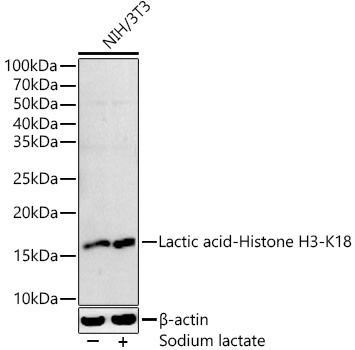
Western blot analysis of various lysates using Lactic acid-Histone H3-K18 Rabbit mAb (A21214) at 1:1000 dilutionincubated overnight at 4°C. HeLa, NIH/3T3 and C6 cells were treated with Sodium lactate (100 mM) for 24 hours. Secondary antibody: HRP-conjugated Goat anti-Rabbit IgG (H+L) (AS014) at 1:10000 dilution. Lysates/proteins: 30 µg per lane. Blocking buffer: 3% nonfat dry milk in TBST. Detection: ECL Basic Kit (RM00020). Exposure time: 90s. |
Product Guarantee and Expert Support
