

Cleaved Caspase-7 Rabbit mAb, Unconjugated, Monoclonal
Catalog Number:
ABB-A23154
- Images (1)
| Article Name: | Cleaved Caspase-7 Rabbit mAb, Unconjugated, Monoclonal |
| Biozol Catalog Number: | ABB-A23154 |
| Supplier Catalog Number: | A23154 |
| Alternative Catalog Number: | ABB-A23154-100UL,ABB-A23154-20UL |
| Manufacturer: | ABclonal |
| Host: | Rabbit |
| Category: | Antikörper |
| Application: | ELISA, WB |
| Species Reactivity: | Human |
| Immunogen: | Synthetic peptide. This information is considered to be commercially sensitive. |
| Conjugation: | Unconjugated |
| Alternative Names: | MCH3, CMH-1, LICE2, CASP-7, ICE-LAP3, Cleaved Caspase-7 |
| This gene encodes a member of the cysteine-aspartic acid protease (caspase) family. Sequential activation of caspases plays a central role in the execution-phase of cell apoptosis. Caspases exist as inactive proenzymes which undergo proteolytic processing at conserved aspartic residues to produce two subunits, large and small, that dimerize to form the active enzyme. The precursor of the encoded protein is cleaved by caspase 3 and 10, is activated upon cell death stimuli and induces apoptosis. Alternatively spliced transcript variants encoding multiple isoforms have been observed for this gene. |
| Application Dilute: | WB,1:1000 - 1:2000|ELISA,Recommended starting concentration is 1 µg/mL. Please optimize the concentration based on your specific assay requirements. |
| Application Notes: | Cross-Reactivity: Human. ResearchArea: Cancer,Invasion and Metastasis,Signal Transduction,ErbB-HER Signaling Pathway,Cell Biology Developmental Biology,Apoptosis,Caspases,Inhibition of Apoptosis,Death Receptor Signaling Pathway,Endocrine Metabolism,Neuroscience,Neurodegenerative Diseases. Shipping: Ice Bag |
|
|
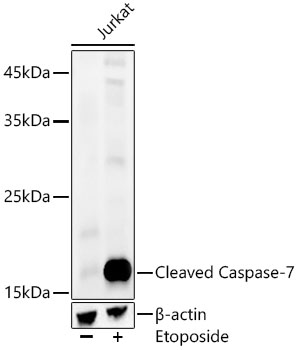
Western blot analysis of lysates from Jurkat cells using Cleaved Caspase-7 Rabbit mAb (A23154) at 1:1000 dilutionincubated overnight at 4°C. Jurkat cells were treated with Etoposide (25 µM) at 37°C for 5 hours. Secondary antibody: HRP-conjugated Goat anti-Rabbit IgG (H+L) (AS014) at 1:10000 dilution. Lysates/proteins: 25 µg per lane. Blocking buffer: 3% nonfat dry milk in TBST. Detection: ECL Basic Kit (RM00020). Exposure time: 30s. |
Product Guarantee and Expert Support
