

CDK5R1 Rabbit mAb, Unconjugated, Monoclonal
Catalog Number:
ABB-A23427
- Images (1)
| Article Name: | CDK5R1 Rabbit mAb, Unconjugated, Monoclonal |
| Biozol Catalog Number: | ABB-A23427 |
| Supplier Catalog Number: | A23427 |
| Alternative Catalog Number: | ABB-A23427-100UL,ABB-A23427-20UL |
| Manufacturer: | ABclonal |
| Host: | Rabbit |
| Category: | Antikörper |
| Application: | ELISA, WB |
| Species Reactivity: | Human |
| Immunogen: | Synthetic peptide. This information is considered to be commercially sensitive. |
| Conjugation: | Unconjugated |
| Alternative Names: | p23, p25, p35, CDK5R, NCK5A, CDK5P35, p35nck5a, CDK5R1 |
| The protein encoded by this gene (p35) is a neuron-specific activator of cyclin-dependent kinase 5 (CDK5), the activation of CDK5 is required for proper development of the central nervous system. The p35 form of this protein is proteolytically cleaved by calpain, generating a p25 form. The cleavage of p35 into p25 results in relocalization of the protein from the cell periphery to nuclear and perinuclear regions. P25 deregulates CDK5 activity by prolonging its activation and changing its cellular location. The p25 form accumulates in the brain neurons of patients with Alzheimers disease. This accumulation correlates with an increase in CDK5 kinase activity, and may lead to aberrantly phosphorylated forms of the microtubule-associated protein tau, which contributes to Alzheimers disease. |
| Application Dilute: | WB,1:2000 - 1:4000|ELISA,Recommended starting concentration is 1 µg/mL. Please optimize the concentration based on your specific assay requirements. |
| Application Notes: | Cross-Reactivity: Human,Mouse,Rat. ResearchArea: Epigenetics Nuclear Signaling,Signal Transduction,Kinase,Serine threonine kinases,Cell Biology Developmental Biology,Apoptosis,Cell Cycle,Neuroscience,Neurodegenerative Diseases,Amyloid Plaque and Neurofibrillary Tangle Formation in Alzheimers Disease. Shipping: Ice Bag |
|
|
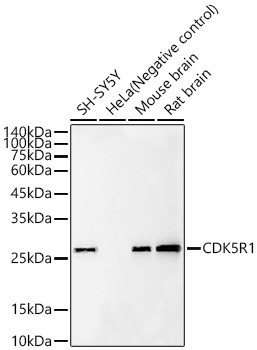
Western blot analysis of various lysates, using CDK5R1 Rabbit mAb (A23427) at 1:4000 dilution. Secondary antibody: HRP-conjugated Goat anti-Rabbit IgG (H+L) (AS014) at 1:10000 dilution. Lysates/proteins: 25µg per lane. Blocking buffer: 3% nonfat dry milk in TBST. Detection: ECL Basic Kit (RM00020). Exposure time: 30s. |
Product Guarantee and Expert Support
