

GSTA2 Rabbit pAb, Unconjugated, Polyclonal
Catalog Number:
ABB-A7678
- Images (1)
| Article Name: | GSTA2 Rabbit pAb, Unconjugated, Polyclonal |
| Biozol Catalog Number: | ABB-A7678 |
| Supplier Catalog Number: | A7678 |
| Alternative Catalog Number: | ABB-A7678-100UL,ABB-A7678-20UL,ABB-A7678-1000UL,ABB-A7678-500UL |
| Manufacturer: | ABclonal |
| Host: | Rabbit |
| Category: | Antikörper |
| Application: | ELISA, WB |
| Species Reactivity: | Human |
| Immunogen: | Recombinant protein (or fragment).This information is considered to be commercially sensitive. |
| Conjugation: | Unconjugated |
| Alternative Names: | GST2, GTA2, GTH2, GSTA2-2, GSTA2 |
| Cytosolic and membrane-bound forms of glutathione S-transferase are encoded by two distinct supergene families. These enzymes function in the detoxification of electrophilic compounds, including carcinogens, therapeutic drugs, environmental toxins and products of oxidative stress, by conjugation with glutathione. The genes encoding these enzymes are known to be highly polymorphic. These genetic variations can change an individuals susceptibility to carcinogens and toxins as well as affect the toxicity and efficacy of some drugs. At present, eight distinct classes of the soluble cytoplasmic mammalian glutathione S-transferases have been identified: alpha, kappa, mu, omega, pi, sigma, theta and zeta. This gene encodes a glutathione S-tranferase belonging to the alpha class. The alpha class genes, located in a cluster mapped to chromosome 6, are the most abundantly expressed glutathione S-transferases in liver. In addition to metabolizing bilirubin and certain anti-cancer drugs in the liver, the alpha class of these enzymes exhibit glutathione peroxidase activity thereby protecting the cells from reactive oxygen species and the products of peroxidation. |
| Clonality: | Polyclonal |
| Molecular Weight: | 26kDa |
| NCBI: | 2939 |
| UniProt: | P09210 |
| Purity: | Affinity purification |
| Sequence: | MAEKPKLHYSNIRGRMESIRWLLAAAGVEFEEKFIKSAEDLDKLRNDGYLMFQQVPMVEIDGMKLVQTRAILNYIASKYNLYGKDIKEKALIDMYIEGIADLGEMILLLPFSQPEEQDAKLALIQEKTKNRYFPAFEKVLKSHGQDYLVGNKLSRADIHLVELLYYVEELDSSLISSFPLLKALKTRISNLPTVKKFLQPGSPRKPPMDEKSLEESRKIFRF |
| Target: | GSTA2 |
| Antibody Type: | Primary Antibody |
| Application Dilute: | WB,1:500 - 1:2000|ELISA,Recommended starting concentration is 1 µg/mL. Please optimize the concentration based on your specific assay requirements. |
| Application Notes: | Cross-Reactivity: Human,Mouse,Rat. ResearchArea: Cancer,Signal Transduction,Endocrine Metabolism,Drug metabolism. Shipping: Ice Bag |
|
|
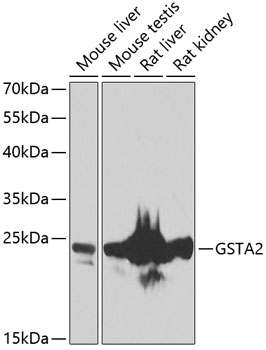
Western blot analysis of various lysates using GSTA2 Rabbit pAb (A7678) at 1:1000 dilution. Secondary antibody: HRP-conjugated Goat anti-Rabbit IgG (H+L) (AS014) at 1:10000 dilution. Lysates/proteins: 25µg per lane. Blocking buffer: 3% nonfat dry milk in TBST. Detection: ECL Basic Kit (RM00020). Exposure time: 90s. |
Product Guarantee and Expert Support
