

RGR Rabbit pAb, Unconjugated, Polyclonal
Catalog Number:
ABB-A7925
- Images (1)
| Article Name: | RGR Rabbit pAb, Unconjugated, Polyclonal |
| Biozol Catalog Number: | ABB-A7925 |
| Supplier Catalog Number: | A7925 |
| Alternative Catalog Number: | ABB-A7925-20UL,ABB-A7925-100UL,ABB-A7925-1000UL,ABB-A7925-500UL |
| Manufacturer: | ABclonal |
| Host: | Rabbit |
| Category: | Antikörper |
| Application: | ELISA, WB |
| Species Reactivity: | Human |
| Immunogen: | Recombinant protein (or fragment).This information is considered to be commercially sensitive. |
| Conjugation: | Unconjugated |
| Alternative Names: | RP44, RGR |
| This gene encodes a putative retinal G-protein coupled receptor. The gene is a member of the opsin subfamily of the 7 transmembrane, G-protein coupled receptor 1 family. Like other opsins which bind retinaldehyde, it contains a conserved lysine residue in the seventh transmembrane domain. The protein acts as a photoisomerase to catalyze the conversion of all-trans-retinal to 11-cis-retinal. The reverse isomerization occurs with rhodopsin in retinal photoreceptor cells. The protein is exclusively expressed in tissue adjacent to retinal photoreceptor cells, the retinal pigment epithelium and Mueller cells. This gene may be associated with autosomal recessive and autosomal dominant retinitis pigmentosa (arRP and adRP, respectively). Alternative splicing results in multiple transcript variants encoding different isoforms. |
| Application Dilute: | WB,1:500 - 1:2000|ELISA,Recommended starting concentration is 1 µg/mL. Please optimize the concentration based on your specific assay requirements. |
| Application Notes: | Cross-Reactivity: Rat. ResearchArea: Signal Transduction,G protein signaling,G-Protein-Coupled ReceptorsGPCR,Neuroscience. Shipping: Ice Bag |
|
|
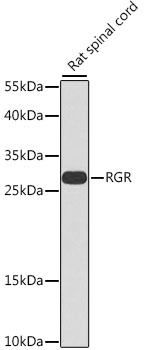
Western blot analysis of lysates from rat spinal cord, using RGR Rabbit pAb (A7925) at 1:1000 dilution. Secondary antibody: HRP-conjugated Goat anti-Rabbit IgG (H+L) (AS014) at 1:10000 dilution. Lysates/proteins: 25µg per lane. Blocking buffer: 3% nonfat dry milk in TBST. Detection: ECL Basic Kit (RM00020). Exposure time: 90s. |
Product Guarantee and Expert Support
