A partial length recombinant TLR5 protein was used as the immunogen for this antibody.
Alternative Names:
Toll/interleukin-1 receptor-like protein 3, TIL3
Toll-like receptor 5 (TLR5) plays a fundamental role in pathogen recognition and downstream signaling to induce effective immunity. It is well expressed in major old tissues including lung, skin, intestine, and spleen. TLR5 is present in synovial of patients with rheumatoid arthritis (RA), act as novel mediator of innate immunity-induced osteoclastogenesis and bone loss. TLR5 is a receptor for flagellin and is present on the basolateral surface of intestinal epithelial cells. It is involved in the migration of intestinal epithelial cells through activation of the p38 MAPK pathway. TLR5-mediated signaling specifically enhanced the maturation of lung dendritic cells. TLR5 influences the progression and outcome of ovarian, sarcoma, and luminal breast tumors. Mutations in TLR5 have been associated with both resistance and susceptibility to systemic lupus erythematosus, and susceptibility to Legionnaire disease.
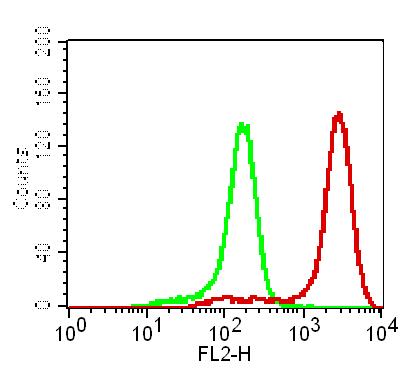
Figure-1: Cell surface flowcytometry analysis of hTLR5 on human PBMC (Monocytes) using 0.5 µg/10 6 Cells of Anti-TLR5 antibody (Clone: ABM22C2). Green represent isotype control and red represent Anti human TLR5 antibody (Abeomics 10-3014). Goat anti mouse PE conjugated was used as the secondary antibody.
* VAT and and shipping costs not included. Errors and price changes excepted