

ATP6V0C Rabbit mAb, Unconjugated, Monoclonal
Catalog Number:
ABB-A23757
- Images (1)
| Article Name: | ATP6V0C Rabbit mAb, Unconjugated, Monoclonal |
| Biozol Catalog Number: | ABB-A23757 |
| Supplier Catalog Number: | A23757 |
| Alternative Catalog Number: | ABB-A23757-20UL,ABB-A23757-100UL |
| Manufacturer: | ABclonal |
| Host: | Rabbit |
| Category: | Antikörper |
| Application: | ELISA, WB |
| Species Reactivity: | Human |
| Immunogen: | Synthetic peptide. This information is considered to be commercially sensitive. |
| Conjugation: | Unconjugated |
| Alternative Names: | ATP6V0C, ATP6C, ATP6L, ATPL, VATL, VPPC, Vma3, ATPase H+ transporting V0 subunit c |
| This gene encodes a component of vacuolar ATPase (V-ATPase), a multisubunit enzyme that mediates acidification of eukaryotic intracellular organelles. V-ATPase dependent organelle acidification is necessary for such intracellular processes as protein sorting, zymogen activation, receptor-mediated endocytosis, and synaptic vesicle proton gradient generation. V-ATPase is composed of a cytosolic V1 domain and a transmembrane V0 domain. The V1 domain consists of three A and three B subunits, two G subunits plus the C, D, E, F, and H subunits. The V1 domain contains the ATP catalytic site. The V0 domain consists of five different subunits: a, c, c, c, and d. This gene encodes the V0 subunit c. Alternative splicing results in transcript variants. Pseudogenes have been identified on chromosomes 6 and 17. |
| Application Dilute: | WB,1:500 - 1:1000|ELISA,Recommended starting concentration is 1 µg/mL. Please optimize the concentration based on your specific assay requirements. |
| Application Notes: | Cross-Reactivity: Human. ResearchArea: Cancer,Signal Transduction,Endocrine & Metabolism. Shipping: Ice Bag |
|
|
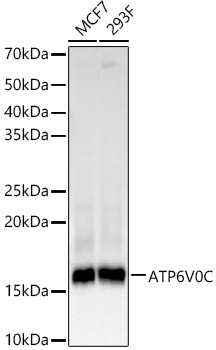
Western blot analysis of various lysates, using ATP6V0C Rabbit mAb (A23757) at 1:1000 dilution. Secondary antibody: HRP-conjugated Goat anti-Rabbit IgG (H+L) (AS014) at 1:10000 dilution. Lysates/proteins: 25µg per lane. Blocking buffer: 3% nonfat dry milk in TBST. Detection: ECL Basic Kit (RM00020). Exposure time: 10s. |
Product Guarantee and Expert Support
